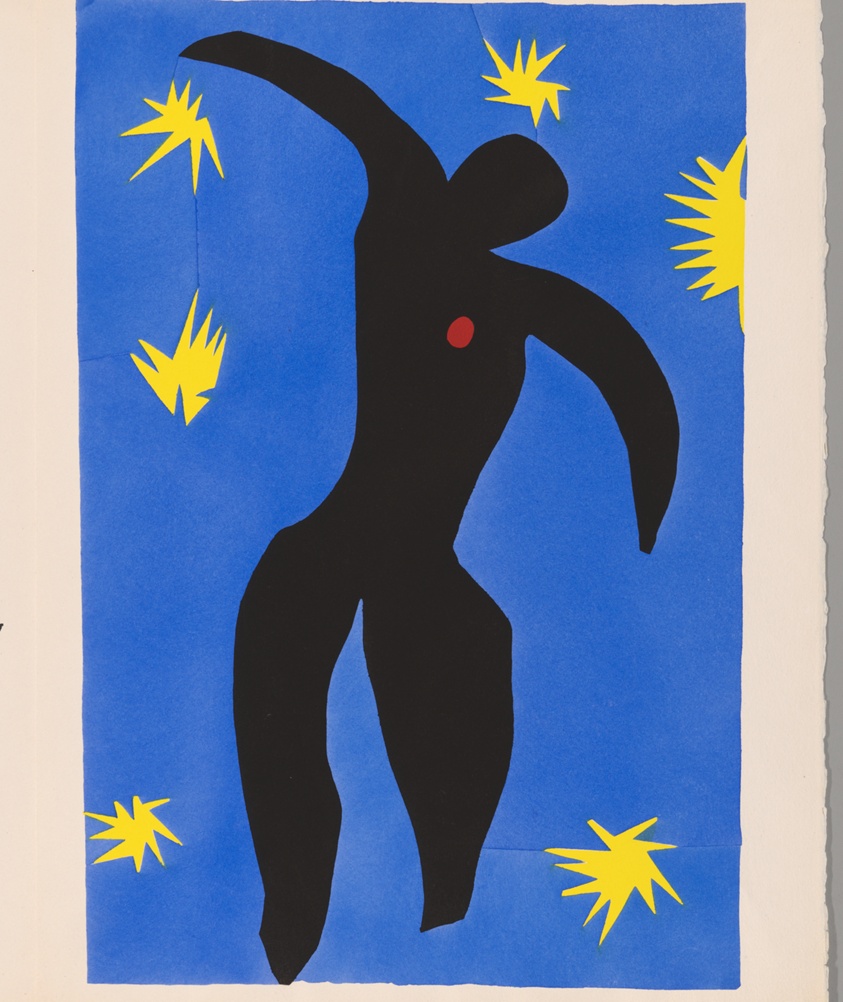
Henri Matisse — Icare, Jazz, 1947
ICARE
After the score by Igor Markevitch, 1932
The first-ever staging of a ballet that waited ninety-three years to be brought to life.
93 years of waiting. A world premiere for our time.
Igor Markevitch composed L'Envol d'Icare for the Paris Opéra, commissioned by Serge Lifar. Lifar admired the score — “The music was admirable, the idea of uniting it with dance seductive, but I had the clear sense that I would never manage to bring my rhythm into accord with Markevitch's” — and the premiere was put off for decades.
Years of silence. The score waited for the stage. It was played in concert, by Markevitch and later by his pupils, but no choreographic version was ever staged.
Artem Hordieiev creates the first full stage production of the work. The world premiere comes ninety-three years on.
“Icarus did not fall because he was careless or reckless. From the very start, he chose to fly — consciously.”
— Artem Hordieiev, Choreographer
Three Axes of the Concept
The production unfolds in three philosophical steps, which together form a stage language of its own.
A way of looking at things
An event in life is neither positive nor negative; in itself it is neutral. Only our attitude gives it a role, a colour, an intention. This echoes the Stoics, who taught that the only thing truly in your power is your attitude to what happens.
Interpretation of Icarus’s Flight
The SUN opens its doors to a “new” Icarus of the twenty-first century, because he did not stop: he took the challenge as it is. He let the Sun scorch and the Moon cool. The body as the instrument of will: not the mind, not a weapon — the body itself makes the breakthrough. In place of humanity's eternal striving for the impossible, a human being accomplishing the impossible, as a conscious choice. Like Ukrainian resistance.
Matisse + Body Syntax
Matisse’s Icarus as a fundamentally different, alternative iconography. Not a human flying towards the sun, but a human who IS the sun. It may become the final image of the production.
L'Envol d'Icare
Igor Markevitch, Paris, 1932
Duration: 27 minutes. Performed by the Belgian National Orchestra.
Available for World Premiere
ICARE is open to conversations with theatres, festivals and producing organisations — the key partners for its first staging anywhere in the world.
Contact the choreographerart_om@me.com